

How to run a quiz night that actually works
How many questions, how long each one, how to handle mixed knowledge, and how to avoid the point where everyone quietly checks out. A format that holds.
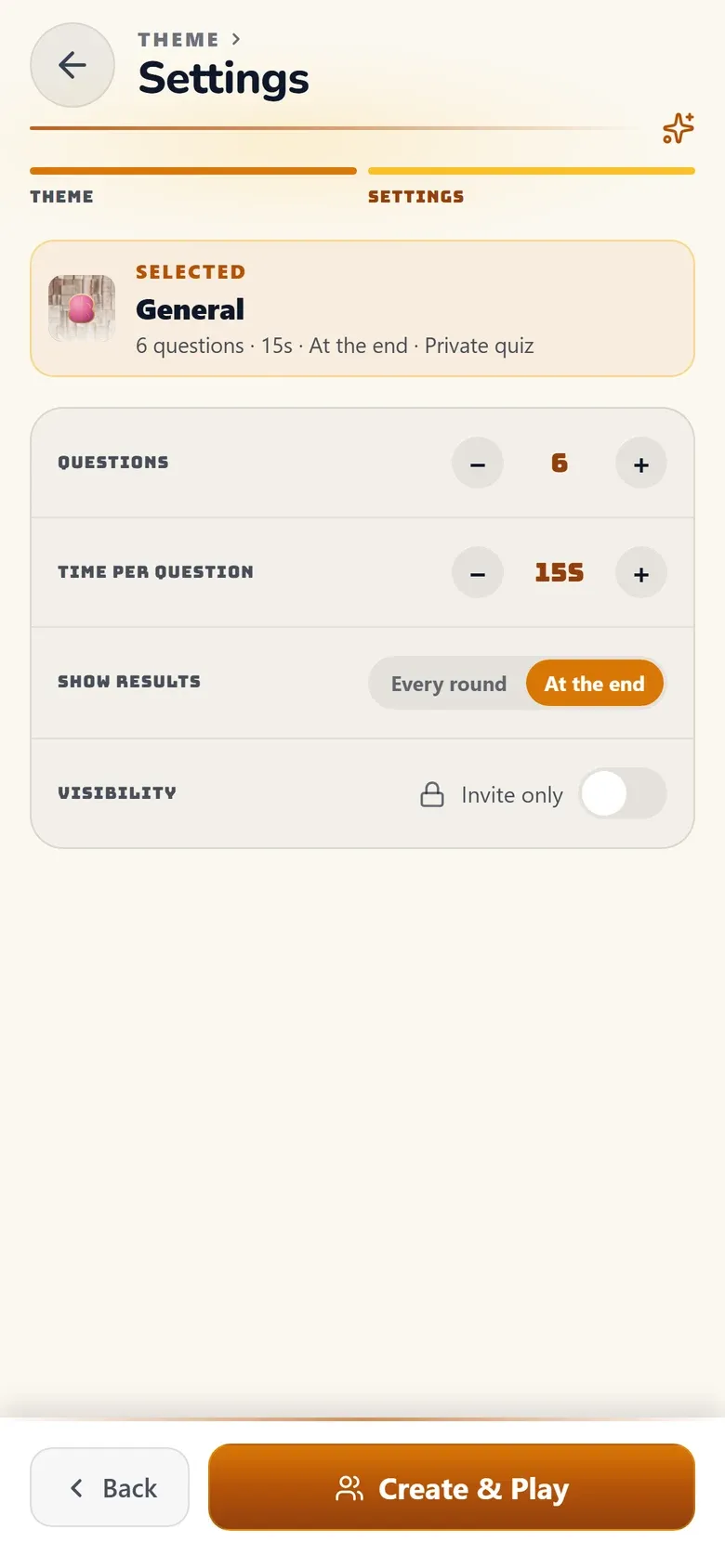
Most quiz nights fail the same way: too long and too hard. People drift around question twelve, somebody picks up their phone, and the game peters out instead of ending.
Here is a format that holds, and the settings that actually matter.
Short wins, almost every time
Twelve to fifteen questions. That is the window where attention holds without effort. Under ten and there is no time for a rivalry to form; past twenty you need a break, and a break in the middle of a quiz is usually the end of the quiz.
If you want to play longer, run two short games instead of one long one. The standings reset, whoever started badly is back in it, and nobody gives up mentally at question seven.
Time per question: shorter than you think
Ten seconds is enough for a multiple-choice question. It feels brutal; in practice, someone who knows the answer gives it in three seconds, and someone who doesn’t will not find it in thirty.
A long timer doesn’t reward knowledge. It rewards discreet searching under the table.
A visible countdown also changes the room: it creates the small spike of panic that makes people shout the answer. That moment is the reason everyone is here.
Mix the difficulty — never ramp it
The classic mistake is ordering questions from easiest to hardest. The problem: the end of the game becomes a wall where only two people are still scoring and everyone else watches.
Mix them. A hard question in second place wakes the room up; an easy one near the end keeps everybody in the race. The goal is not to identify the cleverest person — it is to keep the outcome uncertain until the last question.
Pick a subject the group genuinely shares
This is the only real lever. General knowledge works anywhere, but a quiz about your thing — the series everyone watched, last night’s match, ten years of this friend group — produces a completely different night, because every answer sets off a story.
Two ways to get there:
- A ready-made theme, for zero preparation. EpiQuiz’s themes cover about thirty subjects, questions and answers included.
- Your own subject, if the group has a shared obsession. The quiz generator writes questions from a live web search, so you can start from something recent.
Let everyone play on their own phone
The old format — a host reading questions aloud, teams writing on paper — has one flaw: the host doesn’t play. That is usually the person who organised the night, and they spend it counting points.
Giving everyone their own screen fixes it: nobody hosts, everyone plays, and the standings update themselves. That is the idea behind playing with friends: one game, one code, everyone joins.
Check the questions before you trust the quiz
If you generate a quiz automatically there is a real risk: most tools ask a language model for questions and it answers from memory, and a model that doesn’t know invents rather than staying quiet. You only find out when somebody reaches for their phone to check — and then the game stops.
Look at whether the tool searches for the information before writing, and whether it tells you where it came from. There is a full explanation in how AI quiz generators actually work.
The short version
| Setting | What works |
|---|---|
| Number of questions | 12–15, or two short games |
| Time per question | 10 seconds |
| Difficulty | Mixed, never ramping |
| Subject | Whatever the group shares |
| Format | Everyone on their own phone |
| Questions | Checked, with a source |